
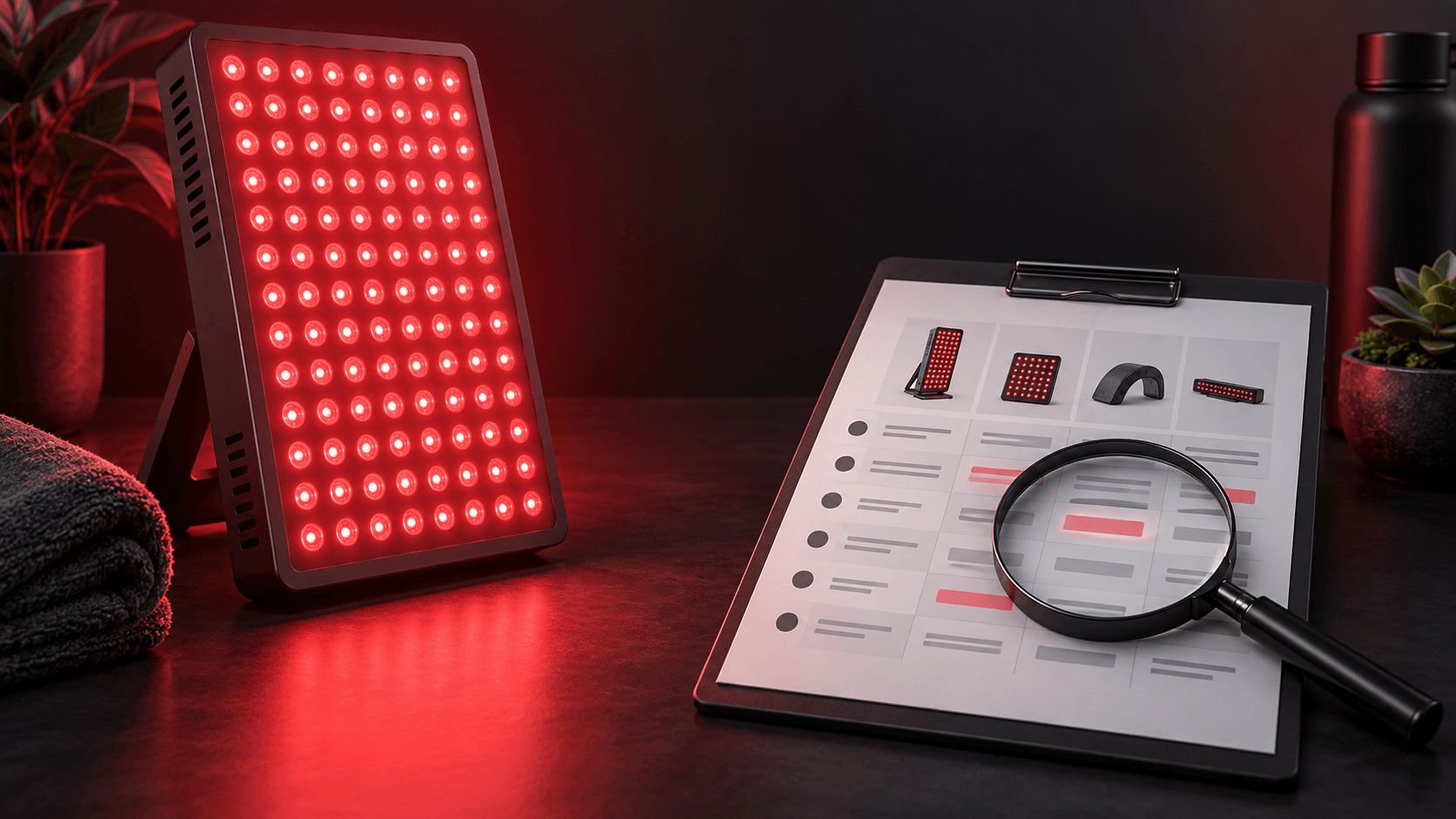
How to choose a light therapy device? 2 most important parameters that determine its effectiveness
When choosing a red light therapy device, it is worth checking two technical parameters first: irradiance and wavelength and its accuracy:
- Irradiance (mW/cm²) shows how much light power falls on a given surface area of the body;
- Wavelength (nm) shows what spectrum of red or near infrared light the device generates.
The values of these indicators reveal the effectiveness of the light therapy device, so it is worth starting with them. However, if the devices being compared have very similar or equivalent irradiance and wavelengths, we recommend additionally evaluating the irradiance measurement distance, the actual illuminated body area, and the ability to control the intensity and individual wavelengths. These additional criteria will help to see the differences between similar panels.
1. Irradiance – how much light energy reaches the body?
Irradiance shows how much optical power is per square centimeter of illuminated surface. In red light therapy devices, it is usually indicated in mW/cm² and is one of the most useful parameters when choosing a light therapy device.
It is important not to confuse irradiance with the total power of the device. If the product name indicates 1500 W, 3000 W or 6000 W, this does not mean that such optical power reaches the human body. This number may be related to the theoretical power of the LED diodes, and not to the actual light intensity. For example, there are two light sources of the same total optical power, one of which directs the light to a very small area, and the other distributes it over a much larger surface. Thus, it should be appreciated that although the power of the two devices is the same, the irradiance reaching the body surface is different.
Scientists also agree that the power of the light source alone is not enough and that the area over which this power is distributed needs to be assessed. Therefore photobiomodulation in the literature The irradiance of a light therapy device is evaluated along with its wavelength, exposure time, energy density, and other light parameters.
Does higher irradiance always mean a better device?
No. A higher mW/cm² number means higher light intensity, but in photobiomodulation, more does not automatically mean better. For example, PBM in research describes the so-called biphasic dose response, according to which too low a light intensity or dose may not be sufficient, but increasing it does not increase the effect indefinitely. There is a certain range of parameters, and too high an intensity or too long an exposure does not necessarily enhance the biological response. This shows that a 200 mW/cm² light therapy panel is not automatically better than a 100 mW/cm² panel.
In order to truly assess irradiance when choosing a red light therapy panel, we recommend also analyzing such indicators as:
- At what distance was the irradiance measured;
- Is this a real, not a theoretical indicator?;
- What wavelength of light is being measured;
- How long is it recommended to use the device?.
And what does J/cm² mean?
Irradiance represents the instantaneous intensity of light, but photobiomodulation also uses energy density – J/cm²:
J/cm² = W/cm² × procedure duration in seconds.
Energy density helps to understand how much energy is transferred throughout the process, for example, 50 mW/cm² corresponds to 0.05 W/cm². So, if this intensity is applied for 100 seconds, 5 J/cm² of energy is obtained on the surface. However research shows that the same dose of J/cm² delivered at different irradiances and over different times does not necessarily produce identical biological responses. Therefore, irradiance is considered one of the main dosing parameters in light therapy.
2. Wavelength accuracy – what spectrum of light does the body receive?
The wavelength indicates what spectrum of light the device generates and is measured in nanometers - nm. Red and near-infrared light wavelengths commonly found in PBM devices are 630, 660, 670, 810, 830, and 850 nm, as well as other wavelengths in the vicinity. In scientific works The spectrum of wavelengths used is wider, so it can be said that today there is no single universal wavelength that would be suitable for all cases. Light of different spectra penetrates tissues differently, i.e. the 600–700 nm range is associated with irradiation of superficial tissues, while the longer NIR wavelengths of 780–950 nm are associated with greater tissue penetration.
In other words, the 660 nm wavelength is in the red light range, while 850 nm is in the near-infrared wavelength, invisible to the human eye. However, not only their visibility differs, but also their interaction with tissues, so in order to achieve the best effect, modern whole-body light therapy panels usually combine both wavelengths.
We recommend that the user evaluates, what specific wavelengths the manufacturer has chosen and are they clearly stated in the technical specification.
Does more wavelengths mean a better device?
Not necessarily. Six, seven or ten wavelengths are not in themselves proof of greater effectiveness. A light therapy panel with more wavelengths is more versatile, but it is important to understand which specific wavelengths are used, how much light power each one has, and whether they can be controlled. For example, six well-chosen wavelengths of red and NIR light may be more valuable in practice than ten wavelengths whose actual power the manufacturer does not provide any information about.
Therefore, when evaluating light therapy panels, attention should be paid not only to the number of wavelengths, but also to their spectrum and purpose.
Irradiance and wavelength must be considered together
Irradiance shows how much light a light therapy device emits, and wavelength shows what kind of light it is. A device may have the right wavelengths but very low light intensity. Another may display an impressive mW/cm² number but not provide clear information about the spectrum or measurement distance. Therefore, when choosing a light therapy device, the first thing to consider is: what specific wavelengths the device emits and What is its irradiance at a real usage distance?.
What if it turns out that competing light therapy models are very similar or identical in these indicators?
Practical example: MITO LIGHT Master 5.0 and Dermfix RLF6000 comparison
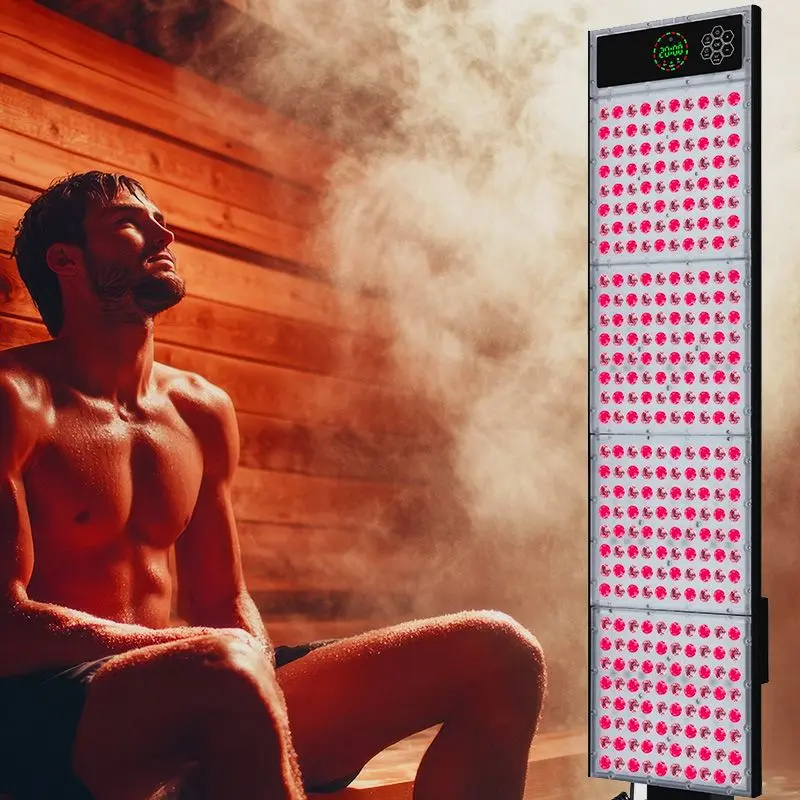
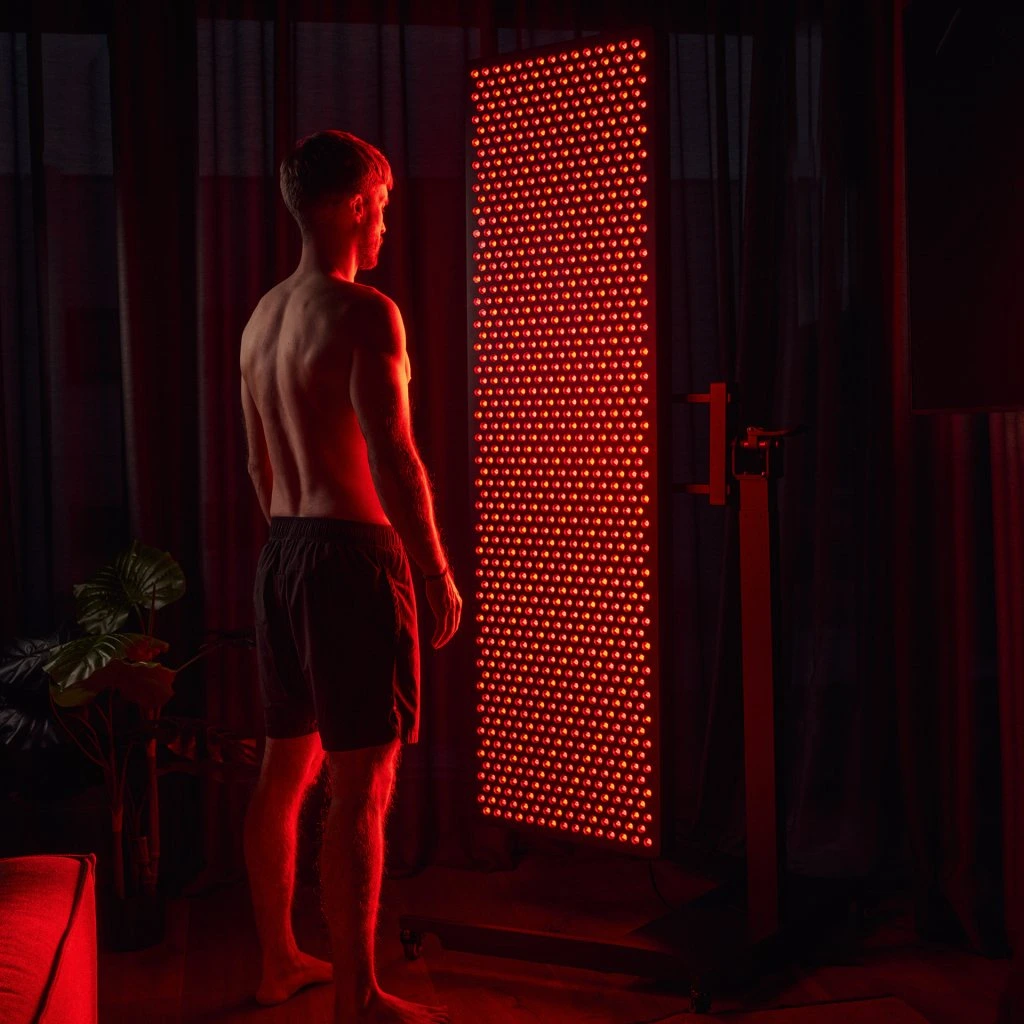
MITO LIGHT Master 5.0 and Dermfix RLF6000 irradiance are almost identical, but their wavelength sets are slightly different. The manufacturer of MITO LIGHT Master 5.0 states 90 mW/cm² irradiance at 15 cm distance, measured by a spectrometer. The panel uses wavelengths of 630, 660, 670, 810, 830 and 850 nm. Dermfix RLF6000 declares at the same distance of 15 cm 92 mW/cm² spectrometer measured irradiance and uses 480, 630, 660, 810, 830, 850 and 1060 nm. Dermfix also states that the intensity of each wavelength can be adjusted from 0-100 %.
The difference in irradiance between 90 and 92 mW/cm² is very small, so no significant advantage can be given to any model based on this parameter alone. The five main wavelengths – 630, 660, 810, 830 and 850 nm – also coincide. MITO LIGHT additionally has a 670 nm, and Dermfix – a 1060 nm NIR and a 480 nm blue light channel.
This comparison illustrates an important rule well: Two main parameters allow you to quickly distinguish between technically very different devices, but when they are very similar, more parameters need to be compared. The choice of a light therapy device should then be determined by the actual conditions of use, the area to be illuminated and the ability to control the light. Therefore, in our opinion, the most important additional criteria for a light therapy device are: irradiance measurement distance, actual illuminated body area and light control options.
1. At what distance was the irradiance measured?
Irradiance measurement distance The same device can have very different mW/cm² values at different distances. Therefore, 150 mW/cm² of a panel from one manufacturer is not necessarily a better result than 100 mW/cm² of a panel from another manufacturer. The first indicator could have been measured directly at the panel, and the second at a real usage distance of 20 or 30 cm.
Therefore, irradiance should be evaluated at several distances, for example:
- 15 cm – X mW/cm²;
- 30 cm – X mW/cm²;
- 45 cm – X mW/cm².
When comparing different models of light therapy devices, try to use measurements taken at the same or at least very similar distances.
2. Panel size and actual illuminated body area
High irradiance at one point does not tell you how much of the body can be illuminated at one time. Therefore, for whole-body therapy, the size of the light therapy panel and the actual illumination area become an important additional criterion for a light therapy device. A small light therapy panel may have high irradiance, but it will need to be moved several times to illuminate the entire body. Meanwhile, a larger one can cover almost the entire front or back of the body at once.
For example, the dimensions of the MITO LIGHT Master 5.0 are 183 × 53 cm, while the Dermfix RLF6000 is 180 × 60 cm. Both models are aimed at full-body use, but the Dermfix is slightly wider and the MITO LIGHT is slightly taller.
When evaluating other models, it is important to look not only at the dimensions of the panel itself, but also at the LED arrangement, the beam angle, and how evenly the light is distributed at the recommended distance.
3. Intensity and wavelength control
When the basic optical characteristics are similar, control capabilities can become the real difference between two devices. Adjustable intensity and separate control of different wavelengths provide more options for customizing the panel for a specific application. We recommend evaluating whether the light therapy device allows for:
- Adjust the light intensity;
- Separately control RED and NIR light;
- Do not measure the intensity of individual wavelengths;
- Set the procedure time;
- iSave the most frequently used modes.
For example, MITO LIGHT Master 5.0 allows for individual adjustment of the intensity of all six wavelengths, and the manufacturer of the Dermfix RLF6000 also specifies separate adjustment of seven channels 0–100 %. These are functions that become relevant when the main optical parameters between models are almost the same.
How do you practically compare two light therapy devices?
Start the comparison with two parameters and only then, if they are similar, move on to the others. This sequence allows you not to get lost among dozens of technical characteristics.
So, first answer these questions:
- What specific wavelengths does the device use?
- What is its irradiance in mW/cm²?
If both models are similar, check three more indicators:
- At what distance was the irradiance measured?
- What area of the body does the device illuminate at one time?
- How can the intensity and different wavelengths be adjusted?
Our experience shows that for most users, these five steps are more than enough to compare light therapy devices, and the first two help to quickly rule out devices whose technical characteristics are not clearly presented.
FAQ
Conclusions
When choosing a red or near-infrared light therapy device, you don't need to start with a long table of technical parameters. First, compare two things – irradiance and wavelengths. They provide the most information about the intensity and spectrum of light a device can deliver to the body. However, when comparing very similar light therapy panels, you need to compare more metrics than we have covered in this article to make a final decision.
Quick reminder:
- Irradiance mW/cm² shows the light intensity in a given area;
- The wavelength in nm indicates the spectrum of the light used;
- A higher mW/cm² or a higher number of wavelengths does not automatically mean that a light therapy device is better;
- Irradiance should be compared at the same or similar distance;
- If the two main parameters of the light therapy device are similar, compare the illuminated area and control capabilities;
- The best choice is not the one with the most numbers, but the one that offers clearly measured parameters that are suitable for your needs.
To put these criteria into practice and compare specific panels sold in Europe, read an overview of the best red light therapy devices in Europe.