

How does red light therapy work?
Have you ever felt exhausted? It could be your cells signaling that they need to recharge. Red light therapy is a natural way to boost your energy levels. Light of a certain wavelength reaches cells and "stimulates" processes related to energy production, inflammation regulation and tissue repair
Think of your cells as tiny batteries. Red and near-infrared light can penetrate your skin and recharge these cellular batteries, promoting healing and providing energy.
Why red light? This specific wavelength of light is absorbed by mitochondria, the powerhouses of our cells. When mitochondria absorb this light, they become more efficient and produce more energy that your body can use.
It all started in the dark when NASA discovered the benefits of red light therapy while experimenting with plant growth. They found that red light accelerated plant growth and healing in human tissue. Since then, numerous studies have confirmed the benefits of red light therapy.
How red light therapy works
Red light therapy devices emit wavelengths of red and near-infrared (NIR) light, which are similar to part of the sunlight spectrum, but does not contain UV radiation. This means: the therapy is not a „tan“ and should not be compared to „a few hours in the sun“, but it can affect cellular processes, related to energy production and recovery (Harvard Health Publishing: Red light therapy for skin care).
- Red light most often referred to as ~630–700 nm (in some devices, the red limits are "stretched" to ~760 nm);
- Near infrared (NIR) often defined as approximately 700–1400 nm within the limits (NIST: Laser Safety Program (PDF)).
Why does the body "react" to this light?
The main scientific explanation: red and NIR light can be absorbed by cells, especially mitochondria, and this is associated with increased ATP production.
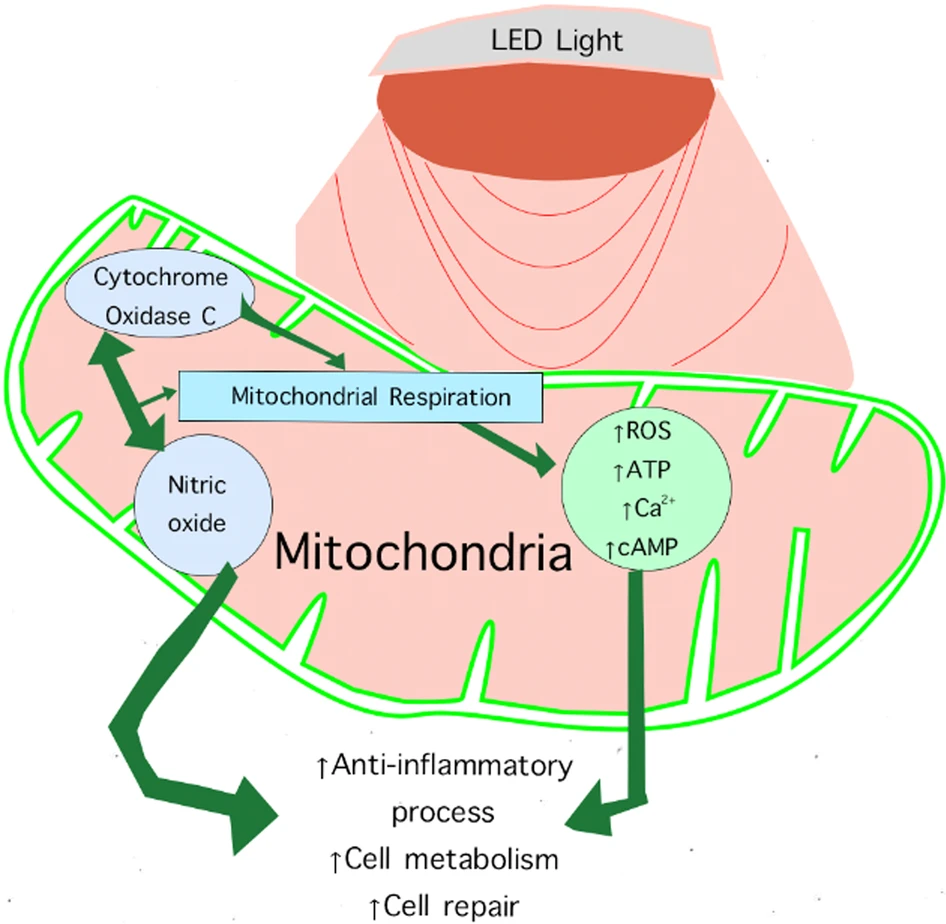
ATP (adenosine triphosphate) is the „fuel“ that cells need for regeneration, normal function, and healing processes (PubMed Central: Brain Photobiomodulation Therapy: A Narrative Review):
- Light is associated with changes in mitochondrial respiratory chain activity and ATP synthesis;
- This can support recovery processes, but the outcome depends on dose, intensity, distance and frequency (PubMedCentral: Brain Photobiomodulation Therapy: A Narrative Review).
660–760 nm red light: what is most commonly used and why?
Red light protocols in cosmetology are often associated with skin appearance goals, as studies evaluate changes related to collagen metabolism and skin quality indicators (PubMed Central: A Controlled Trial to Determine the Efficacy of Red and Near-Infrared Light Treatment in Patient Satisfaction, Reduction of Fine Lines, Wrinkles, Skin Roughness, and Intradermal Collagen Density Increase).
- The most frequently mentioned goals are: skin texture, fine wrinkles, collagen density indicators;
- The studies evaluate the results after a few weeks consistent use, not after multiple sessions (PubMed Central: A Controlled Trial to Determine the Efficacy of Red and Near-Infrared Light Treatment…).
760-1400 nm near-infrared (NIR) light: what does the research show?
NIR light is more often mentioned when talking about deeper tissues achievement and also transcranial (through the head) photobiomodulation is being studied in neurology and mental health. It is important to formulate precisely: effects such as „improve memory“ or „reduce depression“ are not a universal promise for everyone – it is active research area, which contains both clinical trials and reviews (PubMed Central: Near-Infrared Transcranial Radiation for Major Depressive Disorder).
- There are published double-blind, placebo-controlled studies evaluating the use of NIR for depressive symptoms (PubMed Central: Near-Infrared Transcranial Radiation for Major Depressive Disorder);
- There are also reviews describing the mechanisms and potential applications for brain function (PubMed Central: Brain Photobiomodulation Therapy: A Narrative Review).
How does light „turn on“ cellular processes?
Light photons are absorbed in cells, and one of the often mentioned "targets" is part of the mitochondrial respiratory chain - cytochrome c oxidase. This may alter the signaling associated with ATP (energy), reactive oxygen species (ROS), calcium signals and nitric oxide (NO) (PubMedCentral: Photobiomodulation—Underlying Mechanism and Clinical Applications):
- The mechanism often cited is: changes in cytochrome c oxidase activity;
- Possible NO „release“ and signaling changes;
- Low-level ROS may act as a signal rather than a „damage“;
- Results depend on the dose – „more“ does not always mean „better“.
In practice, this means that red light therapy is not an „overnight miracle.“ More often, it is a gentle biological push in the right direction, if the parameters are chosen logically. Therefore, the most common mistake at home is too much distance, too short a time, and too infrequent a frequency. When the protocol „falls apart,“ a person says: „it doesn’t work,“ although in reality he or she is not receiving a sufficient dose. It’s similar to sports: once a month usually doesn’t give an effect. That’s why it’s worth having a clear routine that is easy to repeat.
Why choose red light therapy?
Studies show that red light therapy is a promising direction in the context of skin and some health areas, but the effectiveness depends heavily on the choice of the right equipment and the correct protocol (Harvard Health Publishing: Red light therapy for skin care).
- Choose devices with clear parameters (wavelength, intensity, recommended distance);
- Follow the manufacturer's protocol, as "too short/too far/too infrequent" is usually what creates the impression that it "doesn't work";
- If you have a medical condition, photosensitivity, or are taking photosensitizing medications, it is a good idea to consult a specialist (Cleveland Clinic: Red Light Therapy: Benefits, Side Effects & Uses).
Conclusions
Red light therapy acts as a pulse of energy to cells – mitochondria, which, upon receiving a light stimulus, begin to produce ATP, the energy the body needs for regeneration, healing and repair. As a result, the environment for tissue renewal improves, inflammatory processes are easier to manage, and the skin can look smoother and more vibrant.
Ready to try it? Red light devices emits a concentrated dose of red and near-infrared light to help you feel your best.