Best light therapy devices for thinning hair during menopause: comparing hats, helmets, and headbands
Hair loss becomes more common during perimenopause and menopause, but choosing the right red light therapy device for hair growth can be tricky due to the variety of options available. Some red light therapy devices use lasers for hair growth, others combine lasers with LEDs, and still others rely solely on LED technology. The length of time the devices are used and the cost also vary – treatments can last anywhere from 90 seconds to 25 minutes, and prices can range from hundreds to thousands of dollars.
What type of device is best for menopausal women who notice a widening hairline, decreased hair density, or gradual thinning on the crown of their head?
In this article, we will compare six red light therapy devices available on Amazon.com, explain their key technical features, and discuss what scientific research really says about the effects of light therapy on female pattern hair loss.
Which red light therapy device should I choose for hair loss in a menopausal woman?
There is no one best device for everyone. The choice depends on the cause of hair loss, scalp coverage, budget, and ability to use the device regularly.
Comparison of 6 red light therapy devices
|
Device |
Type |
Light technology |
Manufacturer's recommended use |
|
Helmet |
282 lasers and LEDs, 655 nm |
25 minutes every other day |
|
|
Helmet |
120 lasers and LEDs, 655 nm |
25 minutes every other day |
|
|
High-end helmet |
500 lasers and LEDs, 625/655/680 nm |
12 minutes daily |
|
|
Laser helmet |
80 lasers, about 680 nm |
20 minutes 2 times a week |
|
|
Hat |
120 LEDs, 650nm |
10 minutes daily |
|
|
Laser tape |
82 lasers, 655 nm |
90 sec. 3 times a week |
Specifications are based on manufacturer information. Prices, availability, and customer reviews are subject to change. Usage schedules are for specific models and should not be applied to other devices.
For women looking for a hands-free device that covers a large area of the scalp, this is a good place to start. iRestore Professional. This model has 282 laser and LED light sources operating at a wavelength of 655 nm.
iRestore Essential offers a similar helmet-type design, but has fewer light sources and generally costs less.
For those who want a shorter weekly treatment schedule, it is worth considering Theradome PRO LH80. This device uses 80 lasers, and the manufacturer recommends two 20-minute treatments per week.
Women who don't like the design of a full-face helmet may find it more appealing HigherDOSE Red Light Hat or HairMax LaserBand 82.
1. iRestore Professional – universal helmet-type device
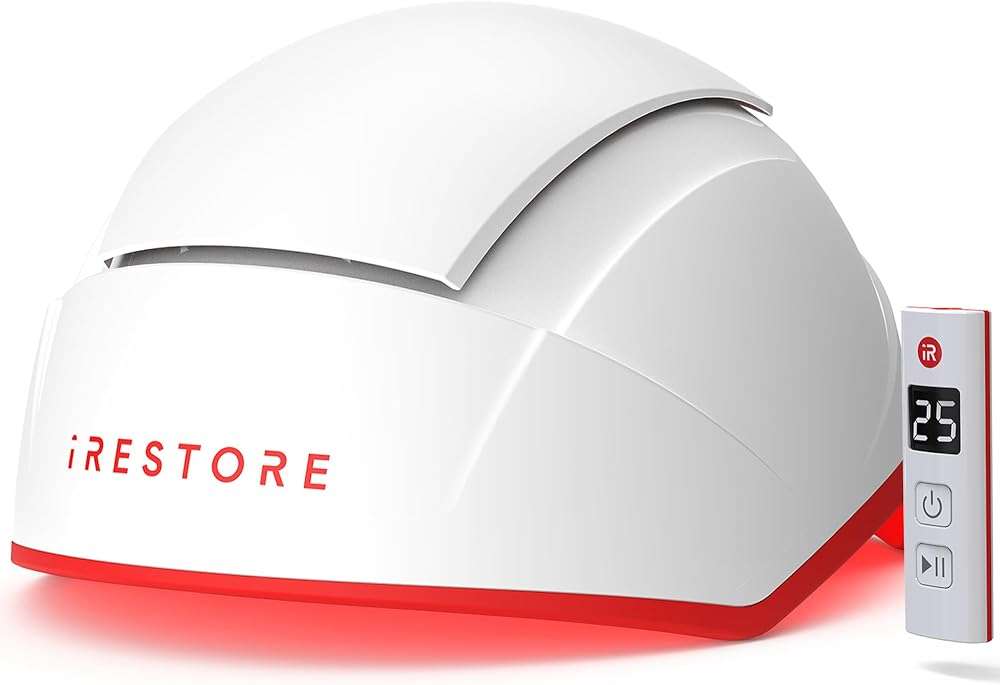
„iRestore Professional is one of the better-known at-home laser hair growth devices.
The helmet design combines 282 laser and LED light sources operating at a wavelength of approximately 655 nm, a wavelength often used in low-intensity light therapy studies related to hair loss.
Unlike handheld devices that need to be moved across the head, the iRestore Professional is designed to light multiple areas of the scalp in a single treatment.
What makes it stand out?
The main advantage is wide scalp coverage and the ability to not use your hands during the procedure.
For women with thinning hair at the parting and crown of the head, this may be more convenient than manually moving a narrow laser strip.
The manufacturer recommends 25-minute treatments every other day. This takes time, but allows you to create a clear routine of use.
„The Professional model has more light sources than the Essential, although a higher number does not necessarily mean better clinical results.
What to pay attention to?
A helmet is less discreet than a baseball cap-style device. It is also worth checking before purchasing whether the kit you choose includes a rechargeable battery, as different kits may have different features.
Who is best suited for: for women who are looking for a device that covers a large area of the scalp and can dedicate 25 minutes to one treatment.
2. iRestore Essential – more affordable choice of helmet type
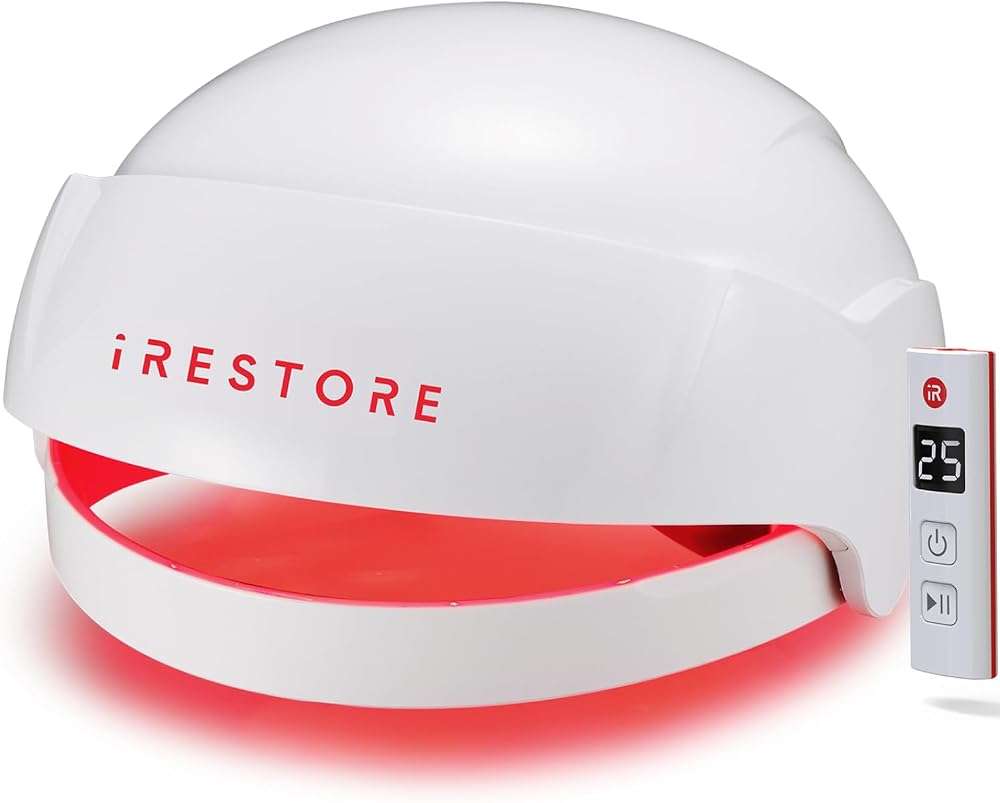
„iRestore Essential works on a similar principle to the Professional, but has 120 laser and LED light sources operating at a wavelength of approximately 655 nm.
According to the manufacturer, they consist of 51 lasers and 69 LEDs.
The main advantage of this model is the ability to use a helmet-type device without spending as much as higher-end models.
Why consider Essential?
Not everyone needs an expensive device with several hundred light sources.
For women considering low-intensity light therapy as part of a long-term hair care plan, Essential offers a similar design and clear usage regimen.
As with Professional, 25-minute treatments every other day are recommended.
What to pay attention to?
„Essential has fewer light sources than Professional or Elite, so you shouldn't assume their scalp coverage and performance are identical.
On the other hand, a more expensive model also does not guarantee proportionally better hair growth.
Who is best suited for: looking for a more affordable helmet-type device from a well-known manufacturer on the market.
3. iRestore Elite – a higher-end helmet with three wavelengths
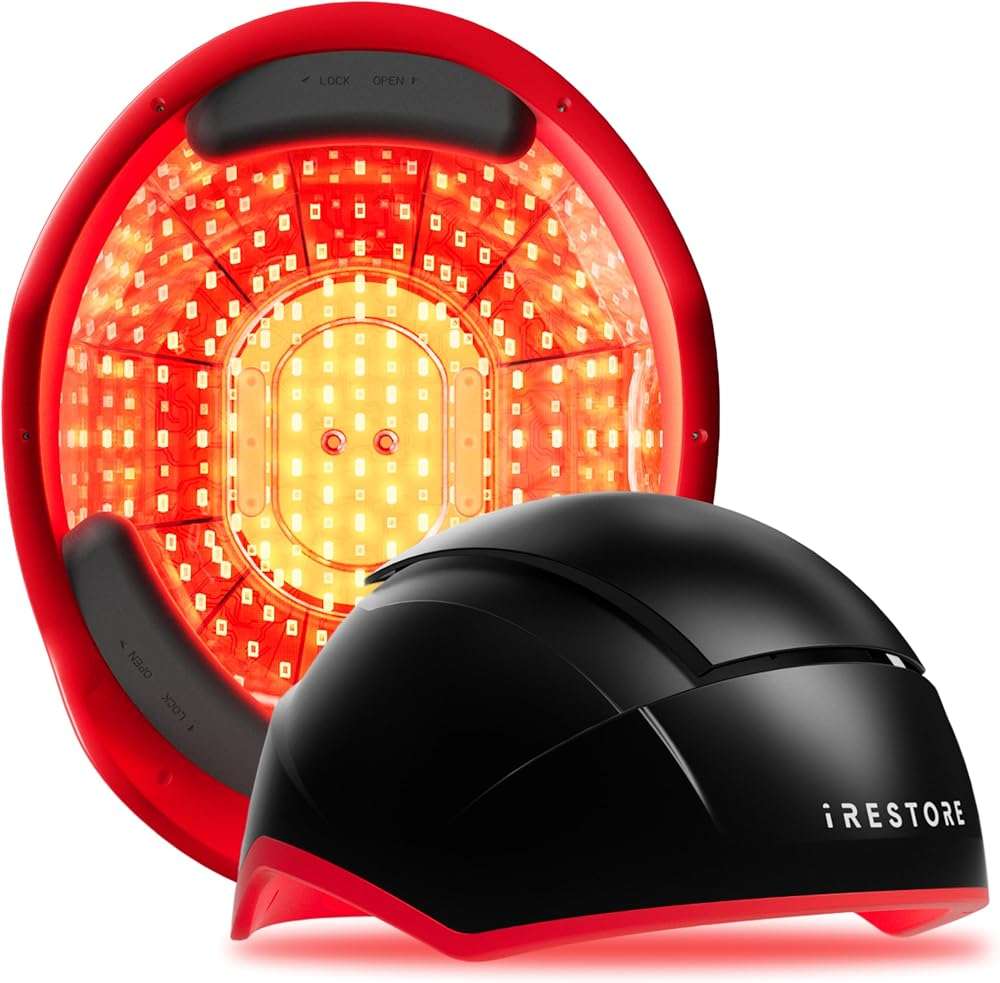
„The iRestore Elite is a higher-end device from this manufacturer, equipped with 500 lasers and LED light sources.
One of its unique technical features is three red light wavelengths: 625, 655, and 680 nm.
The manufacturer also states a total optical power of 2500 mW for the device.
Do three wavelengths give an advantage?
Different wavelengths of light may interact differently with tissues. However, combining multiple wavelengths does not automatically mean better hair growth.
Research suggests that low-intensity light therapy may be beneficial for female-pattern hair loss or male-pattern baldness, but independent head-to-head comparisons proving that Elite outperforms simpler devices are still lacking.
In practical terms, its more important advantages may be its wide light distribution and shorter daily procedures.
It is recommended to use it for 12 minutes daily, and for the Essential and Professional models, 25 minutes every other day.
What to pay attention to?
„The Elite is a significant investment. Its technical features look impressive, but it is important to separate the manufacturer's claims about power and number of light sources from the clinically proven benefits.
Who is best suited for: for those looking for a higher-end device with multiple wavelengths and shorter daily treatments.
4. Theradome PRO LH80 – laser helmet, used twice a week
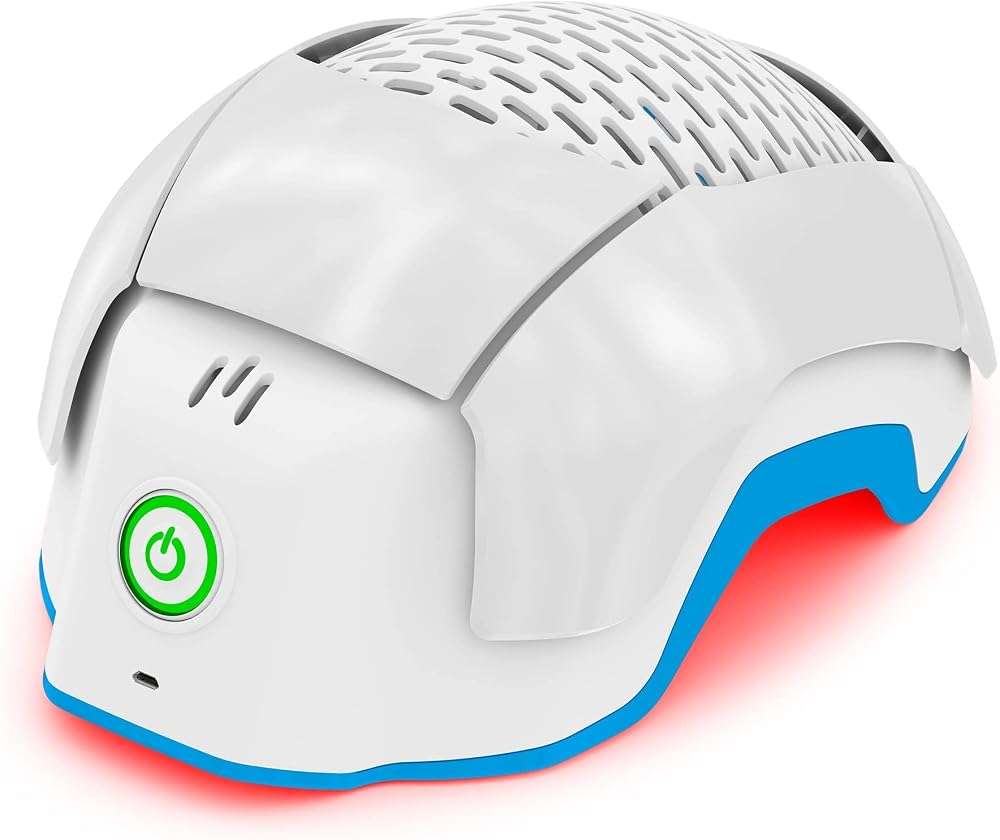
„The Theradome PRO LH80 works a little differently than the iRestore devices.
Instead of combining lasers and LEDs, it uses 80 laser diodes operating at a wavelength of around 680 nm.
This is a wireless, hands-free helmet designed to illuminate the scalp.
One of its most attractive features is the frequency of use.
Why is the frequency of procedures important?
The manufacturer recommends using the Theradome PRO LH80 for 20 minutes twice a week, on non-consecutive days.
For women with busy schedules, two scheduled weekly treatments may be more convenient than daily use.
Regularity is important because the results of low-intensity light therapy are usually seen after several months, not just a few days.
„Theradome laser helmet technology also has a documented history of US FDA 510(k) clearances.
What to pay attention to?
A device using lasers alone is not automatically superior to a combination of lasers and LEDs.
„Theradome has fewer light sources than the iRestore Professional or Elite, but the effectiveness of devices from different manufacturers cannot be compared based on the number of diodes alone.
Who is best suited for: for women who want a wireless laser helmet with a two-treatment per week regimen.
View Theradome PRO LH80 on Amazon.com
5. HigherDOSE Red Light Hat – discreet red light hat
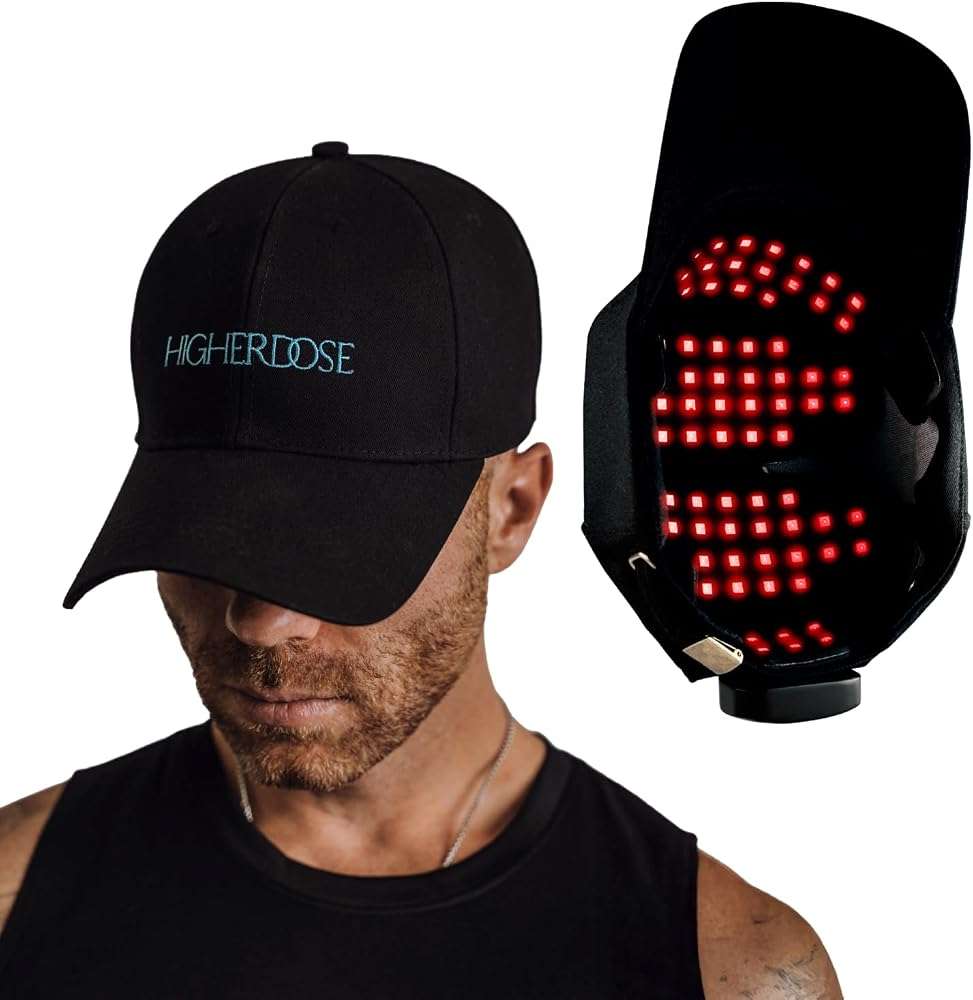
„The HigherDOSE Red Light Hat looks more like a regular baseball cap than a medical helmet.
It is equipped with 120 red light LEDs operating at a wavelength of approximately 650 nm. The device is designed for wireless use.
Unlike some competitors, this model uses LEDs rather than a combination of lasers and LEDs.
Why might a hat be more comfortable?
Comfort depends not only on the duration of the procedure.
Some women don't like wearing a large helmet at home, especially if they want to engage in daily activities during the procedure.
„The HigherDOSE design may appeal to those who value convenience and want a less medical-device-like design.
The manufacturer recommends approximately 10 minutes of daily use.
What to pay attention to?
This is a device based on LED technology. The results of low-intensity light therapy studies do not necessarily mean that every consumer LED device is as effective as laser devices evaluated in clinical trials.
The manufacturer states that its technology has FDA approval, but before purchasing, it is worth checking the regulatory documents and approved purpose of a specific model.
Comfort, hat size, and battery reliability are also important.
Who is best suited for: for those looking for a discreet wireless LED hat with short daily use.
View HigherDOSE Red Light Hat on Amazon.com
6. HairMax LaserBand 82 – laser tape for extremely short procedures
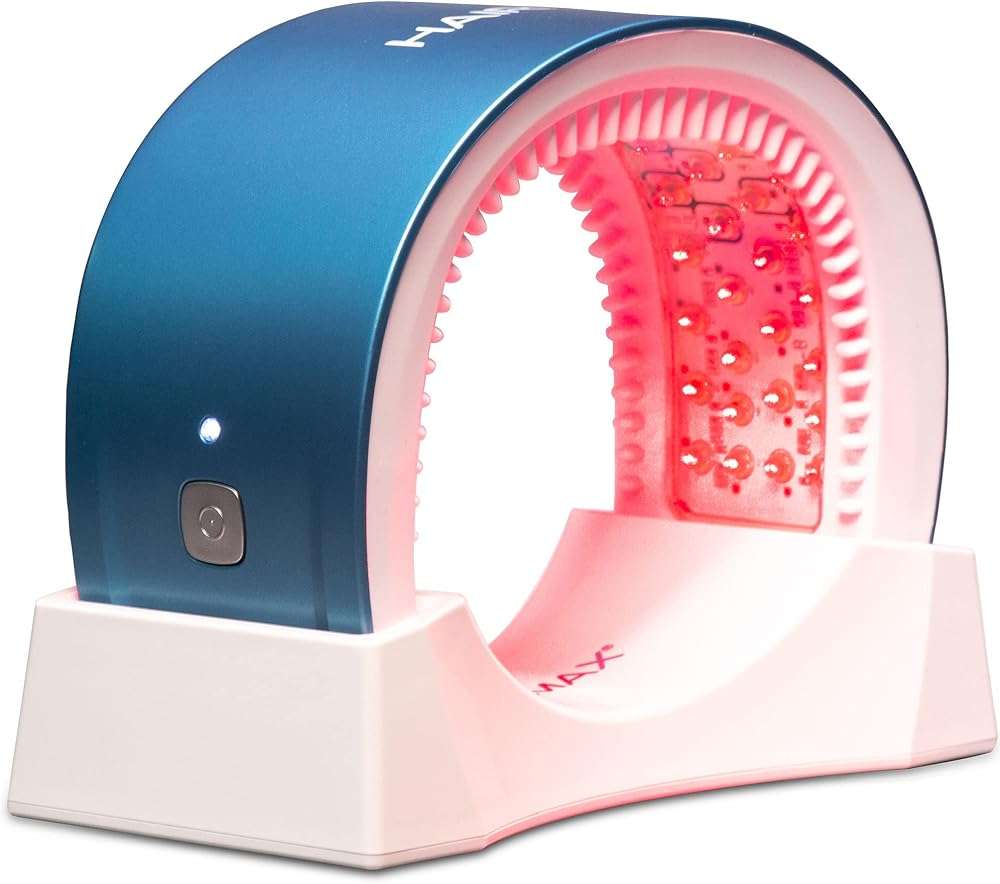
„The HairMax LaserBand 82 ComfortFlex is different from the other devices discussed in this comparison.
Instead of covering the entire scalp at once, this flexible band uses 82 medical-grade lasers operating at a wavelength of approximately 655 nm.
Its design includes special teeth that help part the hair so that light can reach the scalp more easily.
The main advantage is the duration of the procedure
„HairMax recommends a treatment of approximately 90 seconds three times a week.
During the procedure, the tape is held and moved to different areas of the scalp.
For women who find it difficult to regularly dedicate 20 or 25 minutes to a single treatment, this can make a significant practical difference.
The headband may also be suitable for those who prefer a lighter device instead of a bulky helmet.
What to pay attention to?
Since the bar needs to be moved, it is not a completely hands-free device.
The results of its use also depend on correct positioning and following the manufacturer's instructions.
A short procedure time does not in itself prove that the device is more powerful or clinically superior to longer-lasting models.
Who is best suited for: for women who want ultra-short procedures and don't mind manually moving the tape.
Why does hair start to thin in women after 40?
Many women begin to notice changes in hair density in their fourth and fifth decades of life.
The parting may become wider, the ponytail may become thinner, and the scalp may be more visible in bright light.
Perimenopause and menopause can contribute to these changes, as hormonal fluctuations affect the hair growth cycle.
However, menopause is not the only cause of hair thinning.
Female pattern hair loss, medically known as female pattern androgenetic alopecia, becomes more common with age. Other possible causes include thyroid disorders, iron deficiency, medication, stress-induced hair loss, or inflammatory scalp conditions.
This distinction is especially important when considering red light therapy.
A device designed to help with hereditary or female-pattern hair loss will not necessarily help if hair loss is due to untreated nutritional deficiencies, another illness, or scarring alopecia.
According to American Academy of Dermatology, dermatologists may recommend minoxidil, laser therapy, or a combination of these methods for some women experiencing menopause-related hair thinning.
Consulting a doctor is especially important if hair loss starts suddenly, individual bald patches appear, or if you experience pain or inflammation of the scalp.
Does red light therapy really promote hair growth?
Red light therapy for hair is most often discussed using the terms low-intensity light therapy (LLLT), low-intensity laser therapy or photobiomodulation.
These methods use relatively low-intensity light to affect processes occurring in cells.
One proposed mechanism of action involves light absorption in cellular structures involved in energy metabolism, which is thought to affect hair follicle activity.
However, the exact biological mechanisms and optimal procedure parameters have not yet been definitively determined.
What do clinical studies show?
In a 2025 systematic review and meta-analysis The benefits of low-intensity laser and LED therapy in treating various forms of alopecia were evaluated.
The most favorable results were found in cases of androgenetic alopecia, i.e. female- and male-pattern hair loss. There was less evidence for other forms of alopecia.
Other A systematic review of home-use low-intensity light therapy devices showed increased hair growth in participants who used certain comb and helmet-type devices.
Newer research also suggests that some light therapy treatments may increase hair density in androgenetic alopecia. However, the studies used different devices, treatment regimens, and the quality of the studies themselves is variable.
These results are promising, but they don't mean that every red light hat sold online has been independently validated for its ability to promote hair growth.
What results can be expected?
Once the cause of hair loss is properly diagnosed, light therapy can help improve hair density or thickness in some people.
Results usually occur gradually, and in clinical trials, effects are usually assessed after several months.
It would be unrealistic to expect visible hair regrowth after several treatments.
For some people, the changes may be noticeable, while others may experience very little effect or not notice it at all.
Treatment may need to be continued to maintain the results achieved.
Therefore, red light therapy should be viewed as a possible part of a comprehensive hair loss management plan, not a guaranteed solution.
Red light cap, helmet or headband – what to choose?
The differences between these devices are not limited to their appearance.
Red light hats
Hats can be lightweight, discreet, and convenient for use at home.
However, models from different manufacturers differ in light distribution, design and light sources used.
A comfortable-looking hat is not necessarily more effective than a helmet.
Red light helmets
Helmets are usually designed to illuminate multiple areas of the scalp during a single treatment.
They can be convenient for people with widespread hair thinning because they don't need to constantly change the position of the device.
Possible disadvantages include larger dimensions, storage space requirements, and longer procedures.
Laser tapes
Bands may be suitable for buyers who want a smaller device.
Some models feature extremely short treatments, but it is important to move the device properly to illuminate the required areas of the scalp.
Just because a strip focuses light on a smaller area doesn't automatically make it more accurate or effective.
Practical conclusion: Choose a type of device that you can use regularly and correctly. Comfort is important, but clinical evidence and the specific purpose of the device should also determine the final choice.
What should you consider before buying a red light device for hair growth?
1. Wavelength: is 650 nm, 655 nm, or 680 nm better?
Many hair growth devices use light with a wavelength of around 630-680 nm.
All devices compared in this article operate in this range of the red light spectrum.
It may seem that a higher wavelength or a greater number of different wavelengths should lead to a better result, but the clinical effect also depends on the intensity of the irradiation, the duration of the procedure, the dose of light received, and the mode of use.
There is no sufficient basis to claim that a 680 nm device will always be more effective than a 655 nm model.
Also, 850 nm near-infrared light is not a necessary feature of a hair growth device. Clinical studies on hair loss also include devices operating in the visible red light spectrum.
2. Lasers or LED technology?
Lasers emit coherent light, while LEDs typically have a wider range of emitted wavelengths.
Both technologies are used in photobiomodulation, but their optical properties differ.
It is not accurate to assume that a laser device is always superior or that an LED hat will necessarily produce the same results.
The most useful evidence comes from studies conducted using a specific device or similar technology and procedure parameters.
3. FDA approval
Several well-known hair growth devices have US FDA 510(k) clearance for a specific purpose.
It is important to understand that FDA-cleared is not the same as FDA-approved.
A 510(k) clearance generally means that a device has been recognized as substantially equivalent to a suitable, legally marketed device for its intended purpose.
FDA approval also does not guarantee that every person will grow hair back.
Buyers should check the approved indications for use for a specific model and not rely solely on general manufacturer claims.
More information: US FDA – Medical Device Authorization System.
4. Scalp coverage
Women with a widening parting or hair thinning over a larger area may find it more comfortable to use a device that illuminates wider areas of the scalp.
If location is your main concern, you may want to consider a smaller, portable device.
Neither option guarantees better results, but the design of the device should match the area you want to illuminate.
5. Long-term price and ease of use
Price is not the only important criterion.
Before purchasing, it is worth checking the warranty, battery requirements, return policies, additional accessories, and recommended frequency of treatments.
Even a device with impressive technical features can be a poor purchase if it is inconvenient to use.
Can red light therapy be combined with minoxidil?
Low-intensity light therapy is sometimes used in conjunction with established hair loss treatments, including topical minoxidil.
Some clinical trials suggest that combining these approaches may provide additional benefits for certain patients, but research reviews have shown inconclusive results.
Minoxidil remains one of the most widely used, scientifically proven treatments for female pattern hair loss.
For women already using minoxidil or other prescribed treatments, the decision to add light therapy should be discussed with a dermatologist.
A new device should not replace treatment prescribed by a doctor without professional advice.
Frequently asked questions
Conclusion: which red light device is worth choosing for women over 40?
For women who notice gradual hair thinning at the parting or crown of the head, choosing the right device should first start with determining the cause of the hair loss.
Once female pattern hair loss is diagnosed, low-intensity light therapy may be considered as a non-invasive additional treatment method.
Of the six devices compared:
iRestore Professional offers a balanced helmet-style design, a wide scalp illumination area, and convenient hands-free use.
iRestore Essential worth considering when your budget doesn't allow you to choose a higher-end model.
iRestore Elite features multi-wavelength technology and shorter daily procedures, but its higher technical parameters do not guarantee better results.
Theradome PRO LH80 It is distinguished by a regimen of two treatments per week.
HigherDOSE Red Light Hat may be attractive to those for whom a discreet hat design is most important.
HairMax LaserBand 82 is particularly interesting due to its extremely short procedures, although using the tape requires manual repositioning.
Ultimately, successful hair loss management depends on more than just a device. An accurate diagnosis, realistic expectations, and a consistent treatment plan are just as important.
Check out the devices on Amazon.com:
- iRestore Professional;
- iRestore Essential;
- iRestore Elite;
- Theradome PRO LH80;
- HigherDOSE Red Light Hat;
- HairMax LaserBand 82.
Medical information: This article is for informational purposes only and is not a substitute for professional medical advice. Hair loss can have many causes, so treatment should be based on an accurate diagnosis.
Scientific sources and additional information
- American Academy of Dermatology – Female Pattern Hair Loss
- American Academy of Dermatology – Skin and Hair Changes During Menopause
- Low-intensity laser and LED therapy for the treatment of alopecia: a systematic review and meta-analysis (2025)
- Systematic review of home-use low-intensity light and laser therapy devices (2022)
- Using light therapy to treat alopecia (2025)
- US FDA – Medical Device Authorization System